

Settings page

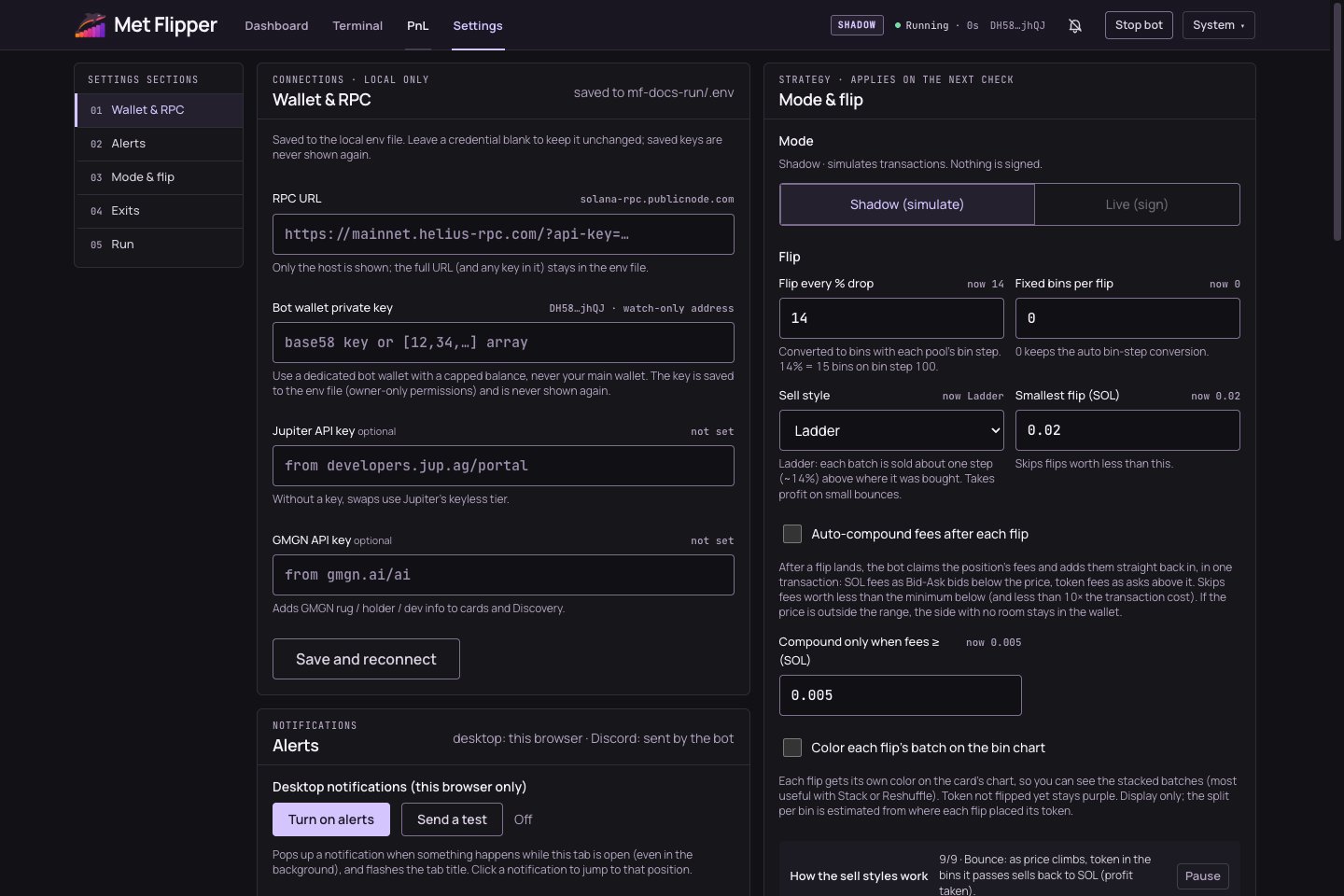
Settings: the section index on the left, Wallet & RPC and Mode & flip. Watch-only test instance.
A Settings sections index sits on the left (numbered 01 Wallet & RPC · 02 Alerts · 03 Mode & flip · 04 Exits · 05 Run). Click one to jump there; the index highlights where you are. Each form tracks its own unsaved changes and has its own save button, which stays visible (sticky) on phones. Every field shows its current value as
now ….There are two kinds of settings:
- Connections (Wallet & RPC, the Discord webhook) are written to the local env file with owner-only permissions. The card header says which file. Saved keys are never shown again.
- Strategy settings (Mode & flip, Exits, Run, Discovery filters, alert types) are saved on the bot and apply on the next check. A value saved here beats the
.envdefault; Default / Reset go back to the.envvalue.
Every strategy key, its default and allowed range is in the Settings reference.
Wallet & RPC
RPC URL (only the host is shown afterwards), bot wallet private key (base58 or the
[12,34,…] array), and optional Jupiter and GMGN API keys. Save and reconnect tests the RPC, saves and reconnects. A watch-only setup shows the watched address here.Alerts
Desktop notifications (this browser) and Discord (sent by the bot), each with per-type toggles. See Alerts.
Mode and flip
Shadow (simulate) / Live (sign). Live asks for confirmation and is disabled for a watch-only wallet or when
ALLOW_LIVE=false. Then flip every % drop (or fixed bins per flip), sell style, smallest flip, auto-compound and its threshold, and per-flip colors on the bin chart. An animated explainer compares the three sell styles:
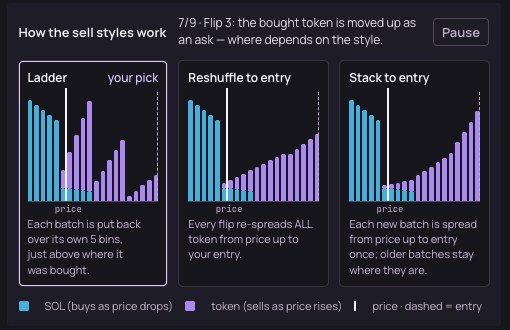
How the sell styles work: Ladder, Reshuffle to entry, Stack to entry.
Exits
Take profit, stop arm level, bounce to cut, hard stop, the above-entry timer and swap leftover token to SOL. See Exits.
Run
Check interval and Discovery interval (each saves on its own), stop and take-profit confirmations, swap slippage and price-impact caps, and priority fees (Auto via Helius with separate levels for exits, a cap, and a fixed fallback).