

How a bid-ask flip works
A DLMM pool splits price into bins. A single-sided SOL Bid-Ask position puts SOL in bins below the current price, with more SOL in the lower bins. When price trades down through a bin, that bin's SOL is swapped into the token. That is how a Bid-Ask range "buys the dip".
The flip is what happens next.
The loop
Read it top to bottom: your SOL waits below the price, falling price fills it with token, each further step down flips that token into sell orders above the price, and a bounce sells it back. An exit rule (take profit, stop, hard stop or the out-of-range timer) can close the whole position at any point.
Step by step
- You open a single-sided SOL Bid-Ask range below the price, from the bot's wallet. The bot detects it within about 30 seconds.
- Entry. With a Helius RPC, the bot reads the pool's active bin at the moment you opened; that's the entry. Otherwise the top of your range is the entry.
- Every step down (14% by default, converted to bins with the pool's bin step: 15 bins on bin step 100, 19 on 80, 8 on 200), the bot withdraws the bins that turned into token and puts that token back as a token-only Bid-Ask ask above the price.
- It does this in one atomic
rebalance_liquiditytransaction. Your SOL bins are never touched and the range never changes, so there is no new rent. - Where the token is offered depends on the sell style.
- Exits close the whole position and swap any token to SOL. See Exits.

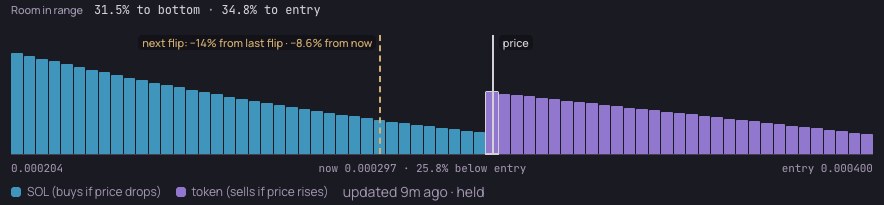
A position card's bin chart: SOL bins (blue) below price, flipped token asks (purple) above.
What it manages, and what it skips
It handles any number of positions on any tokens. Each has its own entry, bin step, flip count and exit state.
It skips:
- pools where SOL is not the quote token,
- layouts with SOL above the price,
- Token-2022 tokens with a transfer fee or transfer hook (a transfer fee would be paid twice on every flip).
PnL follows Meteora's own figure: deposits − withdrawals − fees already claimed, read from Meteora's data API and re-checked every 10 minutes. If you add or remove liquidity by hand, the baseline follows instead of counting it as profit or loss.